 SunDose
Guides
Tanning at UV Index 10: A Guided 20-Minute Session
A UV index of 10 usually gets a one-word answer: don’t. That’s not bad advice. The World Health Organization puts 8–10 in the “very high” band, where unprotected skin burns quickly, and in May 2025 researchers at the International Agency for Research on Cancer attributed more than 80% of the world’s melanoma cases to ultraviolet radiation. And yet people still go outside on those days — for the beach, for a walk, for the twenty minutes they’ve been looking forward to all week. SunDose exists for that gap. Not to argue you indoors, but to make those twenty minutes deliberate. Here’s what a guided high-UV session actually looks like.
Key takeaways
- At UV 8–10 the WHO and US EPA rate the risk very high and advise minimising exposure between 10:00 and 16:00.
- Sunscreen is tested at 2 mg/cm², but people typically apply only 25–50% of that amount (Skin Cancer Foundation) — how much you put on matters as much as the number on the bottle.
- SunDose turns a high-UV outing into a timed 10-minute front / 10-minute back session, with SPF, skin type, medication sensitivities and hydration checked before the timer starts.
What does a UV index of 10 actually mean?
UV 10 sits in the “very high” band of the global UV Index, where the WHO and the US EPA advise minimising sun exposure between 10:00 and 16:00, seeking shade, and generously applying broad-spectrum SPF 30+ every two hours (WHO; US EPA). Ten isn’t the top of the scale — 11+ is “extreme” — but it’s where the margin for error gets thin.
The number people misread is the one in the middle of the day. UV isn’t a flat quantity you can average across an afternoon; it peaks hard around solar noon and falls off sharply either side. That’s why SunDose shows the index hour by hour rather than as a daily headline, and why the app’s Safe Window points at the shoulders of the day instead of the middle. A “UV 10 day” is rarely UV 10 for more than a couple of hours.
If you want the full scale — what 3, 6 and 11+ each mean, and where the WHO protection threshold sits — we mapped it out in our introduction to SunDose.
Why SPF 50 is the floor, not the ceiling
Sunscreen is lab-tested at 2 mg of product per square centimetre of skin, which works out to roughly a shot glass for a whole adult body. In practice, people apply only 25–50% of that (Skin Cancer Foundation, “How Much Sunscreen Is Enough?”). The gap between the SPF on the bottle and the SPF on your skin is mostly a dosage problem, not a product problem.
So SPF 50 at UV 10 isn’t a licence to stay out longer. It’s the baseline the session you already planned depends on. Apply it before you start — not once you’re warm — and reapply at least every two hours, and after swimming or sweating (American Academy of Dermatology). SunDose puts the reapply prompt on the same timer as the session, so it arrives before you’d think to check.
What does SunDose check before the timer starts?
Six things, and none of them take longer than a few seconds once your profile is set: SPF status, skin sensitivities, hydration, skin type, the live UV reading, and where you are in the Safe Window. The point of running them first is that every one of them changes the length of the session, and none of them can be fixed halfway through. They’re the same inputs behind the session timer and routines you’d use on any other day — a UV 10 day just makes each one count for more.
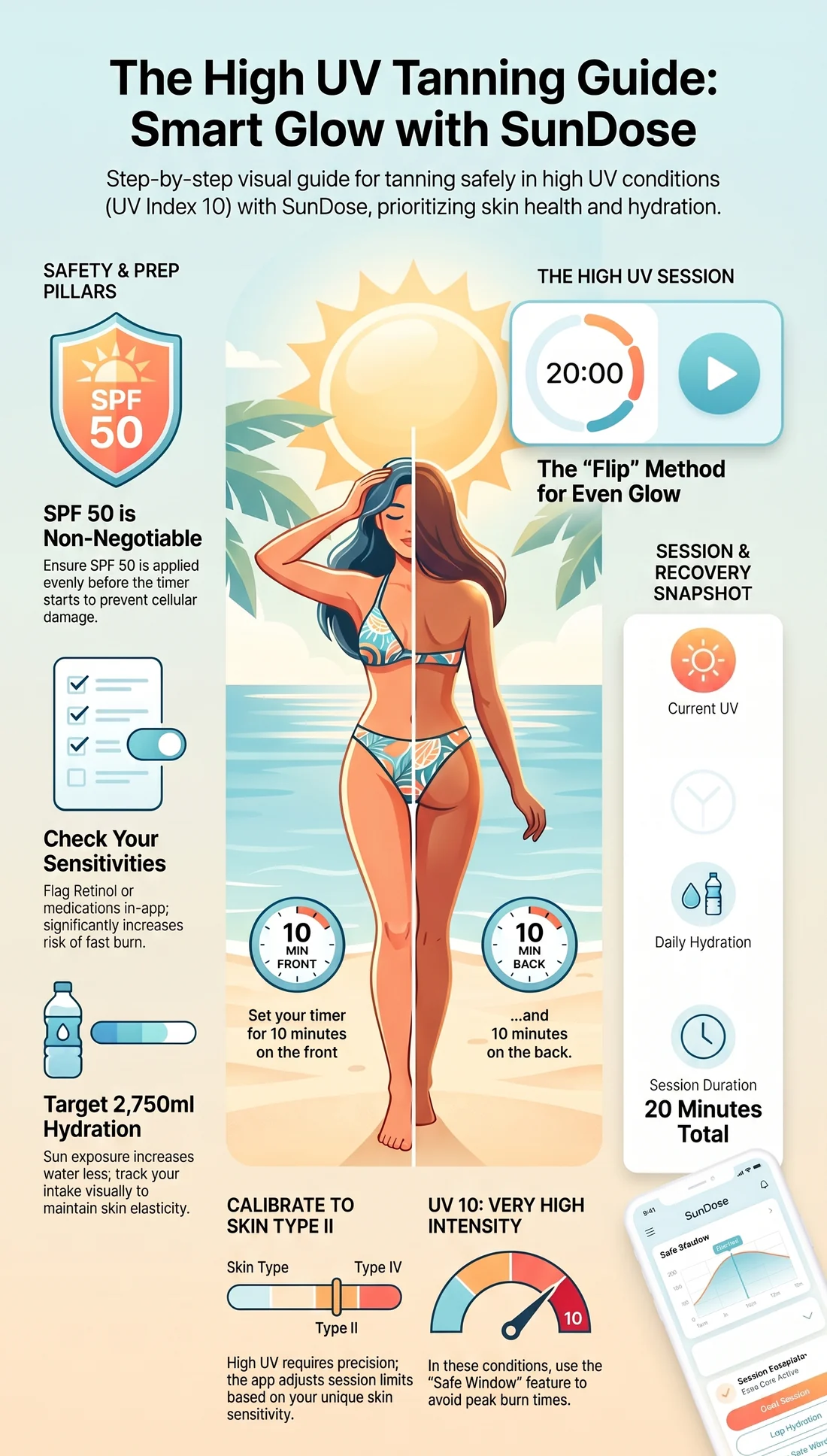
Skin type is the one people skip, and it’s the one that moves the number most. The Fitzpatrick scale runs I to VI; type II burns easily and tans minimally, and types I and II together account for roughly 35% of the US population (StatPearls, NCBI Bookshelf). A type II session at UV 10 and a type V session at UV 10 are not the same session, and a generic timer treats them as though they were.
How does the 10/10 flip method work?
Twenty minutes, split evenly: ten on your front, ten on your back, with the app timing each half and prompting the turn. The split isn’t magic — it’s a way of making exposure even and, more importantly, of giving the session a fixed end point that isn’t your own judgement after forty minutes of sun and a warm towel.
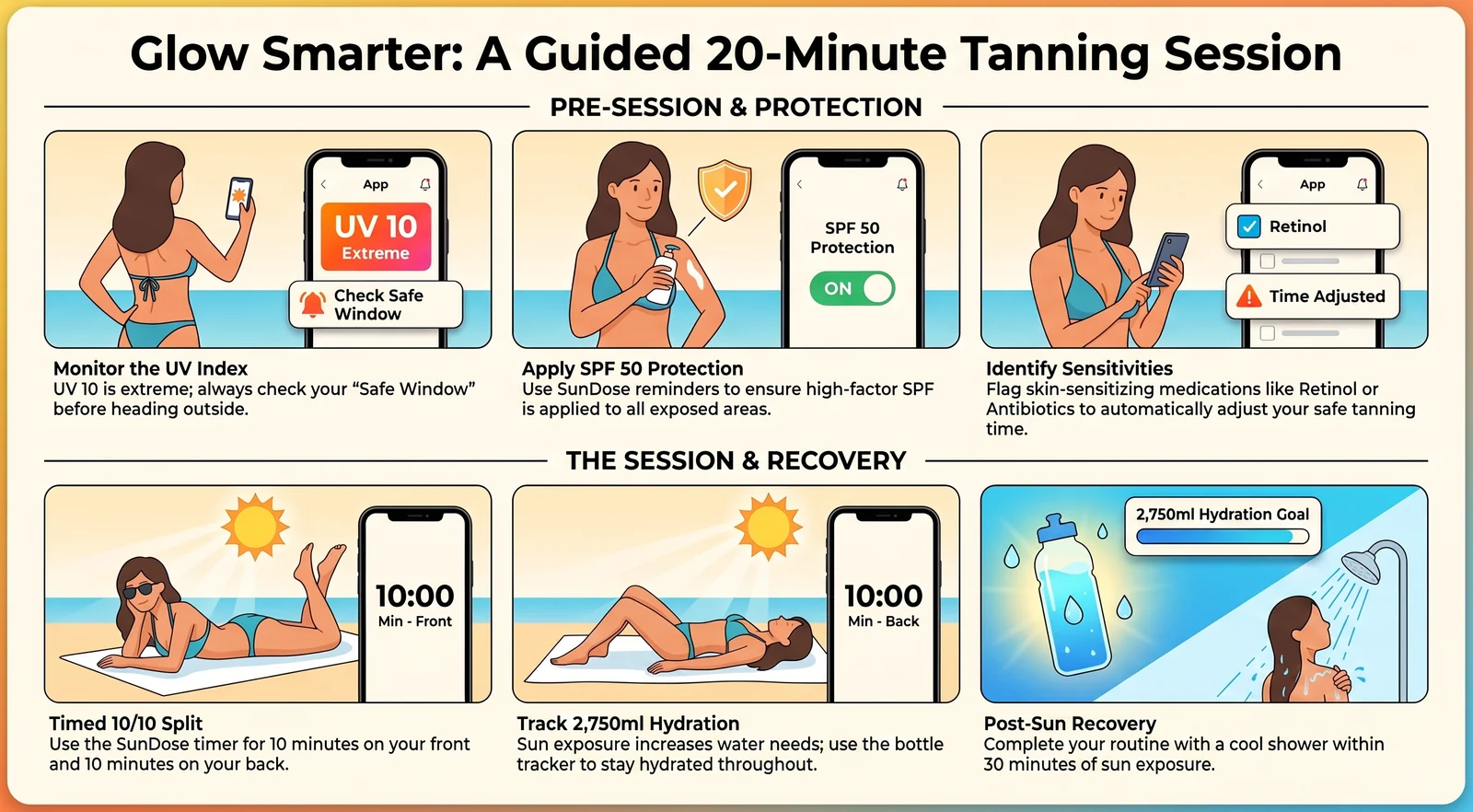
The reason we built the timer as a Live Activity came out of using early builds ourselves. Ten minutes is short enough that people don’t set a timer at all, and long enough that they lose track of it. Putting the countdown on the Lock Screen meant you could check it without sitting up, unlocking, and finding the app — which, in testing, was the difference between the timer being used and being ignored.
Twenty minutes is what the app calculated for the profile in that example: type II skin, SPF 50, no active sensitivities, at UV 10. It is not a universal figure. Change any one of those inputs and the session changes with it, which is rather the point.
Which medications and skincare make you burn faster?
Quite a few, and most people don’t connect the two. Retinoids, tetracycline antibiotics such as doxycycline, quinolones, some NSAIDs and several blood-pressure medicines are all documented photosensitisers — they make skin react to UV faster and more severely than it otherwise would (US FDA, “The Sun and Your Medicine”).
Dose matters too. With tetracyclines, a higher dose generally means greater sensitivity to UV, and doxycycline is the derivative most often implicated. The practical upshot is simple: a retinol serum you started last week can quietly change what a sensible session looks like this week. Flag it in SunDose and the suggested session length adjusts. If a medication label mentions sun sensitivity and you’re not sure what it means for you, ask a pharmacist — that’s a question they answer all day.
How much water does a high-UV day actually need?
More than a normal day, and for a reason that isn’t obvious. The European Food Safety Authority puts adequate daily water intake at 2.0 litres for women and 2.5 litres for men under moderate conditions, and notes those figures should rise with heat and activity (EFSA). Sun exposure adds a second draw: the American Academy of Dermatology explains that a sunburn pulls fluid toward the skin’s surface and away from the rest of the body.
The 2,750 ml in the app isn’t a rule handed to everyone — it’s a target calculated for a specific profile on a specific hot day, sitting a little above the EFSA baseline. What makes it work is the tracking, not the number. A bottle tracker you tap four or five times is a far better prompt than a figure you agreed with in the morning and forgot by two.
What should happen in the 30 minutes after?
Come inside and take a cool shower. The AAD recommends frequent cool baths or showers after sun exposure, moisturising while the skin is still
Frequently asked questions
- Is it safe to tan when the UV index is 10?
- UV 8–10 is rated “very high” by the WHO, and unprotected skin can burn quickly. The safest choice is shade between 10:00 and 16:00. If you do go out, keep exposure short and deliberate, apply SPF 50 generously beforehand, and reapply every two hours.
- How long can you stay in the sun at UV index 10?
- There is no single safe number — it depends on your skin type, your SPF, medications and the exact conditions. SunDose calculates a session length from your own profile rather than a generic figure, and the 20-minute example in this guide is one such calculation, not a universal limit.
- Why split a tanning session into 10 minutes front and 10 minutes back?
- A timed flip keeps exposure even and, more usefully, it gives you a fixed end point. Without a timer most people estimate by feel and overshoot. SunDose runs the split as a Live Activity so you can check progress from your Lock Screen without opening the app.
- Does SPF 50 mean I can stay out longer?
- Not reliably. Sunscreen is lab-tested at 2 mg/cm², but the Skin Cancer Foundation notes people typically apply only 25–50% of that amount. Treat SPF 50 as protection for the time you had planned, not as permission to extend it.
- Which skincare and medications increase sunburn risk?
- Retinoids, some antibiotics (tetracyclines such as doxycycline, and quinolones), certain NSAIDs and some blood-pressure medicines can raise photosensitivity. Flag them in SunDose and it shortens its suggested session accordingly. Check your own labels and ask a pharmacist if you are unsure.
Sources
- World Health OrganizationRadiation: The ultraviolet (UV) index
- US Environmental Protection AgencyUV Index Scale
- International Agency for Research on Cancer (WHO)New study on the global burden of cutaneous melanoma incidence attributable to ultraviolet radiation,
- The Skin Cancer FoundationHow Much Sunscreen Is Enough?
- American Academy of DermatologyHow to apply sunscreen
- American Academy of DermatologyHow to treat sunburn
- US Food and Drug AdministrationThe Sun and Your Medicine
- European Food Safety AuthorityEFSA sets European dietary reference values for nutrient intakes
- Gupta V, Sharma VKLaser Fitzpatrick Skin Type Recommendations,